Found in Translation Reads
How is it only the 7th of February? This week already feels like it’s been 789,245 days long what with the world being turned upside down and all. Speaking of that, a friend suggested I not promote American books because tariffs – which are on, aren’t on, are on, maybe are – who knows?? Either way, I’m taking it under advisement and interested in your thoughts.
I caught part of this interview on Commotion with Elamin Abdelmahmoud on CBC about boycotting America and the meaning of cultural resistance in Canada. I plan to listen to it in full as I consider my own financial and cultural resistance. In the meantime, I’m relieved that this month’s featured books are all from Japan and Korea, so I didn’t have to wrestle with that decision just yet.
I’m sure you’ll be shocked to learn that all three novels this month revolve around the power of books, libraries, and bookstores to change lives. (See above re: cultural resistance.)
Here’s a great article from The Guardian on why Japanese fiction is booming:
“Known in the industry as “healing” or “heartwarming” fiction, comfort books often go unreviewed in the press but represent more than half of the bestselling Japanese fiction titles this year. There are recurring motifs: coffee shops (Toshikazu Kawaguchi’s Before the Coffee Gets Cold); bookstores and libraries (Michiko Aoyama’s What You Are Looking for Is in the Library); and, most of all, cats (Makato Shinkai’s She and Her Cat).”
I’d file all these books under gentle reads, which I equate healing/heartwarming fiction in Korea—a term I love. These books are also much shorter than typical North American novels, not quite novelettes but definitely shorter than you may be used to.
Side note: I also read (but DNF’d) Convenience Store Woman, another popular Japanese book in translation. I couldn’t connect with it. Or maybe something was lost in translation?
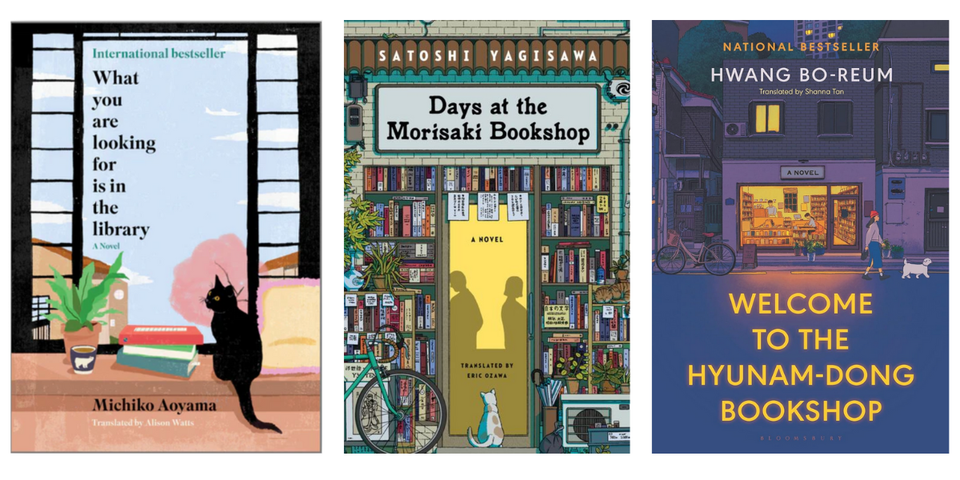
What You Are Looking For Is in the Library by Michiko Aoyama
More a collection of vignettes than a traditional novel, this book follows five library patrons, each at a different life stage—young mothers to recent retirees. What links their stories is a librarian, Sayuri Komachi, who always asks them, “What are you looking for?” and, alongside her recommendations, includes an unexpected book. Somehow, it’s always exactly what they need. A reassuringly cozy read, this novel explores change, personal growth, human connection, and community.
One caveat: The descriptions of the librarian are quite jarring. She’s compared to Baymax and the Stay-Puft Marshmallow Man, leaving me picturing a pale Jabba the Hutt presiding over the library, spreading the power of books. Apparently, body shaming is more acceptable/common in Japan than in North America. While the translator stayed faithful to the original text (as they should; isn’t that part of the point of reading books from other cultures?), it did take me out of the story at times.
Days at the Morisaki Bookshop by Satoshi Yagisawa
When Takako’s boyfriend, Hideaki, abruptly dumps her for another woman he’s planning to marry, her life unravels. She resigns from her job—where both her ex and his new fiancée also work—loses her friends and falls into a deep depression. Enter her eccentric uncle, Satoru, who owns a second-hand bookshop in Jimbocho, Tokyo’s famous book district (I want to go to there). He invites her to stay with him, and although she’s not a reader, she soon falls under the spell of books. Along the way, she reconnects with her uncle, who is nursing his own wounds after his wife abruptly left him five years earlier. Both Hideaki and Satoru’s wife return, forcing Takako and her uncle to make decisions that turn out to be less complicated than they might have imagined. This is another novel that explores the power of books, relationships, family, and community. Sensing an overarching theme yet?
Welcome to the Hyunam-Dong Bookshop by Hwang Bo-Reum
After leaving her high-powered job and unhappy marriage, Yeong-ju is driven by a dream: to open a bookshop. As she builds her store’s clientele and reputation, she also creates a community (see above re: overarching theme)—everyone from her barista to a teenager wrestling with whether or not to go to university to a grammarian author is accepted at her shop. She’s also rebuilding her life after burning out from doing everything she was “supposed” to do with her life. What I found most interesting about this very character-driven and definitely healing book was that many topics – divorce, family alienation, doing what makes you happy and doing it mindfully – are much more revolutionary in Korean culture than in our culture. But the courage it takes to step away from societal expectations? That’s universal. I’ve ordered a copy of this book to keep—it’s the kind that poses knotty questions, the kind I want to underline, revisit, and think through more deeply.
A little something extra that I love: Anyone who knows me knows that tea is my jam. A friend turned me on to Steam Tea House’s After Dark Tea, and now I’m hooked. This robust rooibos-based blend is packed with cocoa kernels and warming spices like cinnamon, ginger, black peppercorn, and cardamom. It’s perfect for an afternoon or evening treat. And since we’re on the topic—talking about books with friends over tea? Pretty much my idea of a perfect afternoon.
If you’re still here, I’d love for you to follow ATKReads on Instagram (I really will get I’ll be more active there soon!). Or, if you know someone who’d enjoy this newsletter, please share it with them and encourage them to subscribe—if it’s their cup of tea. (See what I did there?)
I’d also love to hear your thoughts on any of the books I’ve recommended—we can always chat in this Meta-, X- and algorithm-free space!
Member discussion