So Many Reads (but not all from me!)
This month’s ATK Reads references an odd mix of Ann Patchett, LaineyGossip, Jane Friedman, and our potentially postliterate society.
It’s been a while! I was on a spree of reading ho-hum books. And then summer. And then sandwich generationing. But I finally have a few books I’m happy to recommend!
But before we get to that, earlier this month I was lucky enough to see Ann Patchett in conversation with Leslie Hurtig (the Artistic Director of the Vancouver Writers Fest), and Ann (yes, I’m calling her by her first name) was inspiring. Among many other things, the recent Atlantic article on the end of reading that’s making waves came up (sorry, I don’t have a subscription so I can’t share the full article with you, or read it myself–oh, the irony). In response, Ann mentioned the book The Swerve, which explores the human urge to prophesy the end of the world. Or, in this case, the end of reading. I haven’t read The Swerve, and I’m paraphrasing Ann Patchett, but it’s a bit like Aristotle’s Rhetoric complaining about teenagers these days. So let’s hope that reports of the end of reading are greatly exaggerated.
I’ve read quite a few think pieces about The Atlantic article, including in Jane Friedman’s Bottom Line newsletter, where she said: “Yet another long and predictable story on the death of reading. In a cover story for The Atlantic, Rose Horowitch suggests the age of reading may end up being a historical anomaly…here’s what I’d remember for now: The piece acknowledges that people read constantly in new, digital formats, but it characterizes them as trivial and not as cognitively demanding as books…So many of these reading critiques amount to moral panics, mostly concerned about literary reading and literary books. When the most successful books today (YA or romantasy, for example) are referenced, these are considered indicators that reading is dying...I tire of literary reading nostalgia.”
LaineyGossip also referenced the article: “I read a depressing but also fascinating story reported by Rose Horowitch this weekend about the End of Reading, positing that America isn’t illiterate, it’s postliterate, and that one day if we were to look back at the course of human history, the Age of Reading might be an anomaly. What will the consequences be if thoughtful reading declines to the point of… none? Are we already seeing it happening now?”
In another newsletter I subscribe to, Tasmina Perry writes: “The battle for reading won’t be won by persuading people to buy one more book, or one novel over another. It will be won by making people want to be book readers.” Her piece is worth reading for the conclusion alone:
“Because this isn’t just about declining book sales. It’s about the kind of society we want to live in.
One that values depth over distraction, human thought over algorithms and curiosity over conformity.
A world where being a book reader is something people are proud to be.”
So, without having read The Atlantic article, it seems that whether or not you believe reading is dying out depends in part on how you define reading. If you’ve read the article, I’d love to know what you think!
Back to Ann Patchett. She recommended quite a few books during the event, including (but not limited to) Fair Ones by Lydia Millet, The Left and the Lucky by Willy Vlautin, Sorrow and Bliss by Meg Mason, John of John by Douglas Stuart, Music Against the Night by Yiyun Li, and Colson Whitehead’s newest, Cool Machine, which was just released.
I haven’t read Patchett’s newest, Whistler, yet, and I’m about to read Bel Canto for the first time–I’ll report back!
Okay, that’s a lot of book recommendations already, and here are yet more; these are from me:
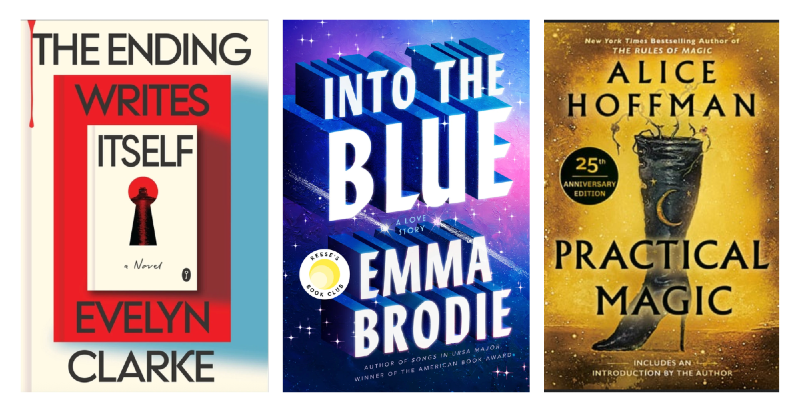
The Ending Writes Itself by Evelyn Clark
Evelyn Clark is the pen name of writers Cat Clarke and V.E. Schwab, neither of whom I’ve ever read, but I’d read another Evelyn Clark book in a heartbeat. If you’ve ever considered writing a book, you’ll appreciate all the references to…well…writing different genres of books in this self-referential Agatha Christie-esque novel. It contains shades of And Then There Were None, with six authors stranded on a private island for 72 hours. Their goal at the beginning of the book is to complete the unfinished novel of a secretly deceased mystery novelist whose success they all aspire to. But in less than 24 hours, they’re trying to solve a murder while also trying to stay alive. It’s a bit silly, very fun, and a great summer mystery read!
Into the Blue by Emma Brodie
If The Ending Writes Itself was the perfect summertime mystery, then Into the Blue is the perfect summer beach read. There is yearning. There is a sci-fi element (though not in the actual plot, have no fear). There is a career-driven woman (in a good way). And a huge roadblock to the happy ending you’ll be rooting for. There are bonus enjoyment points for those in the film and television industry, especially actors, improvisers, and comedy writers. Apparently it’s classified as a rom-traum, “the kind of romance that makes you suffer a little or, realistically, a lot”, which is a new category to me, but one I’m apparently drawn to. It’s also a Reese’s Book Club choice, which may or may not make it more appealing to you.
Practical Magic by Alice Hoffman
What’s the point of summer if not to feel a bit nostalgic for summers of yore? For me, that includes the books of yore as well. When promo started coming out for the Practical Magic 2 movie, I was driven to read the OG source, Practical Magic. It differs from the movie more than I realized, but it’s equally delightful. The cadence it’s written in is reminiscent of classic fairy tales (Brothers Grimm, not Disney), and the sibling relationship is relatable to anyone who has a sibling. It’s delightful and magical, without being twee or precious. It’s also a good reminder that despite the appeal of hot new releases, there’s a huge repository of older books we may not have read that are equally compelling! Be sure to read the 25th anniversary edition with an intro from Alice Hoffman.
AI use statement adapted from Josh Bernoff: I, Annemarie Tempelman-Kluit, a human, wrote every word of this post.
I used AI tools for grammar checking, but used my judgment to select from its suggestions and implement them (or not).
Member discussion